We Had to Travel Fast Before We Learned to Travel Slowly (Part 2)

Wait… what?
Isn’t this article about slow travel?
It is.
But before we became slow travelers, we did exactly the opposite.
Before I continue, there’s one important piece of context. If you’re imagining two twenty-year-olds taking a gap year, that wasn’t us.
When we left to travel, we were already in our thirties. Libby was living and working in Los Angeles, while I was living and working in Switzerland. We’d both been working and studying since leaving school. We had careers, hobbies, routines, friends, and lives that, from the outside, looked completely normal. In fact, I loved my work-life balance so much that my company occasionally had to remind me to take my holiday because I rarely wanted time off.
The problem wasn’t that we were unhappy.
The problem was that we were living on opposite sides of the world.
Anyone who has experienced a long-distance relationship knows how difficult that can be. Every goodbye felt harder than the last, and eventually we reached a point where we had to ask ourselves a simple question.
Do we continue living two separate lives, or do we build one life together?
For us, the answer became obvious.
We weren’t trying to escape our jobs. We weren’t running away from responsibility, and we certainly weren’t searching for ourselves. Quite the opposite, we genuinely enjoyed the lives we had built. But we loved each other more than the comfort of staying where we were.
So we made a decision that, at the time, felt both exciting and terrifying.
We quit our jobs, sold almost everything we owned, and walked away from the lives we had spent years building without really knowing what would come next. People often say, “You can always go back.” But go back to what? We’d deliberately closed that chapter of our lives. Looking back, I don’t think we fully understood how big that decision really was. For the first time since we were teenagers, we had no routine, no career path, and no real purpose other than figuring life out together.
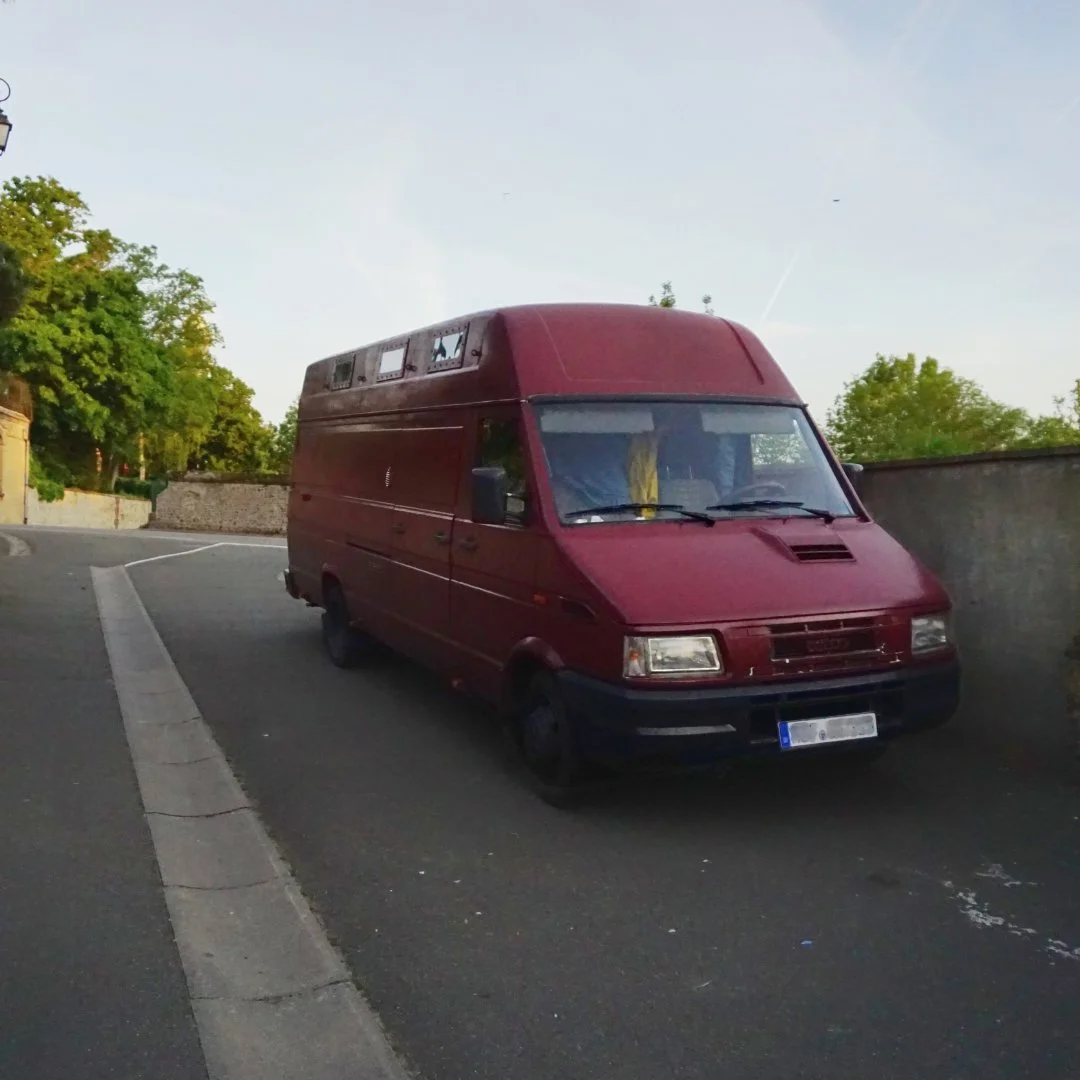
Back in 2015, after making that decision, I bought an old Iveco Daily camper van for just €4,000. To this day, it’s still one of my favorite vehicles I’ve ever owned. We thought we were about to embark on the adventure of a lifetime.
And for a while, it certainly felt that way.
Every morning brought a new destination, every evening we parked somewhere different, and we crossed countries almost without thinking. We drove hundreds of kilometers, watched beautiful landscapes roll past the windows, and convinced ourselves we were seeing the world.
In reality, we realized we mostly saw it through the windshield.
We rarely stayed anywhere for more than twenty-four hours because there was always another town to visit, another viewpoint to reach, another place marked on the map that seemed more important than the one we were already standing in. At the time, we didn’t know any better. How could we? We were simply learning what kind of travelers we wanted to become.
What surprised me most wasn’t how many places we visited. It was how few people we actually met.
During those first four months, despite constantly moving through different countries, I don’t think we had more than ten meaningful conversations. We were always arriving, always leaving, always thinking about tomorrow instead of today.
By the end of that trip, I remember asking myself one simple question.
Is this really what travel is supposed to feel like?
A couple of months later, after selling the Iveco to a friend, we flew straight to Tokyo.
And what did we do?
Exactly what we’d done before.
We rented another camper van.
At the time it seemed like the obvious decision. Staying in Tokyo felt far too expensive, and traveling by camper van was the only way we really knew.
Before picking it up, we stayed in a shared Airbnb filled with students. We paid around fifty dollars for a tiny room, yet when we arrived the bed hadn’t even been made. The shower was in the basement, and I still remember walking downstairs and seeing a student sitting in the narrow hallway quietly eating a bowl of ramen. It was one of those moments where you stop, look around, and think,
We’re paying how much for this?
After that we spent a night sleeping at Haneda Airport before using a free hotel night we’d accumulated through a booking website. Even then I could already feel the money disappearing from our savings.
Eventually I found a small camper van rental company that had only recently started operating. Renting from them became an adventure in itself, and over the years we’ve returned to them another two times and I’m incredibly glad we found them.
But that first trip?
That was quite an experience.
Once again we fell into exactly the same rhythm. We drove from place to place, planned the next stop before we’d really experienced the current one, and watched some of Japan’s most beautiful scenery disappear through the side windows.
I don’t think the camper van was ever the problem. Our mindset was.
We believed traveling meant constantly moving. We thought seeing more places meant having a richer experience, when in reality the opposite was often true. We were so focused on what lay further down the road that we rarely gave ourselves permission to truly experience what was already right in front of us.
At that point, Free To Use Sounds didn’t even exist. It was still more than two years away. We were living from our savings, experimenting with different ideas, and trying to discover something that genuinely felt like us. We even started another YouTube channel because we thought that was what we were supposed to do.
It never felt right.
The videos weren’t us.
The work wasn’t us.
Today, I’m grateful it didn’t succeed. If it had, there’s a good chance Free To Use Sounds would never have existed.
We just didn’t know that yet.
It would take us several more years to understand what those first journeys had really taught us.
Slow travel isn’t about driving fewer kilometers.
It isn’t about staying in one place for a month instead of a week.
For us, slow travel began the moment we stopped measuring a journey by how many places we visited and started measuring it by how deeply we experienced each one.
Looking back after more than eleven years on the road, I wouldn’t change a single part of that journey. Every rushed itinerary, every uncomfortable night, every uncertain moment, and every wrong turn shaped not only the way we travel today, but also the people we’ve become.
What I didn’t realize back then was that traveling is a lot like building muscle.
It takes time.
It takes patience.
And it certainly doesn’t happen overnight.
You don’t step into a gym expecting to lift the heaviest weights. You learn, you adapt, and with every session you become a little stronger. Travel works much the same way. We weren’t bad travelers; we were simply inexperienced. We had to live those first experiences before we could understand what kind of life we were actually looking for.
The funny thing is that, back in 2015, the term slow travel wasn’t even part of my vocabulary. I wasn’t trying to become a slow traveler because I didn’t know such a lifestyle existed.
After Japan, we flew to Indonesia and rented a small house in Ubud, Bali. Today Bali is a very different place, but that’s something every generation seems to say. We met people who had lived there since the early 2000s, and they told us how much it had changed. I’m sure if you had spoken to someone who arrived in the 1980s, they would have told exactly the same story.
For us, however, everything felt new.
We realized that traveling didn’t have to mean living out of a suitcase. We discovered Facebook groups where people advertised apartments, met the owner in person, and moved into our new home that very same day. We bought local SIM cards, rented a scooter, learned where to buy groceries, found cafés we liked, and slowly settled into a routine.
Something felt different.
Some days we explored the island.
Other days we stayed home, cooked dinner, watched a movie, or simply enjoyed doing nothing at all.
It almost felt like normal life, just in a different country.
That feeling surprised us.
We weren’t rushing to the next destination because there wasn’t one. The island would still be there tomorrow. If we wanted to visit a waterfall next week instead of today, we could. If we felt like staying home with a cup of tea while it rained outside or spending the afternoon watching a movie, nobody was telling us we were wasting our time.
I think that was the first glimpse of what slow travel would eventually become for us, even though we didn’t have a name for it yet. We were no longer trying to squeeze every attraction into a few days. Instead, we were slowly becoming part of the rhythm of a place rather than simply passing through it.
Of course, reality was never far away.
Every day we stayed, our savings became a little smaller. Our visas had an expiry date, and there were still many other countries we dreamed of visiting. Somewhere in the back of our minds, there was always a quiet voice reminding us that this lifestyle couldn’t continue forever unless we found a way to make it sustainable.
We didn’t know it yet, but that realization would eventually change everything.